
An Open Letter to the Officers of the First Order Re: Death Star Doctrine

il_340x270.767751302_ps14Note: The following contains spoilers.

An Open Letter To My Fellow Officers of the First Order; Gen Hux et. all.;

I wish to open this letter by acknowledging the difficult month we have shared, collectively, as leaders of the First Order. Most if not all of us reading this memo had close friends and trusted colleagues on Starkiller Base, their loss is a palpable wound.

However, even with the destruction of the Hosnian System and the hated Senate, it is up to us as officers to admit we have, yet again, suffered a defeat at the hands of the Resistance. Morale is at an all-time low. This is why we must be particularly careful not make hasty or foolish decisions without careful consideration of the polices that have led us to this low point in the otherwise glorious history of the First Order.

Which is why when entering a conference room on the leadership deck I was shocked and dismayed to discover a group of high-ranking officers, engineers and financial controllers in the middle of a meeting running over preliminary plans to create something they were calling “Ultimate Super StarKiller Murderbase IV.”

No.

Just stop it. Do you hear me? Stop. It’s time we admit that he First Order, a supposed edification of the Galactic Empire, has problems we can’t Death Star our way out of.

This one is going to be powered by black holes or something and will have a oh dear lord please stop....

This one is going to be powered by black holes or something and dark lord above, enough already….

Do you have any idea the sheer scale of our war-fighting resources directed toward increasing size and complexity high-visibility, concentrated-power destructive bases over the past decades? It’s in the quadrillions. Think of all the ships, troops, manufacturing capability, planning and doctrine we’ve slavishly dedicated to these single-use weapons, and what we have to show for it in return. The Rebellion/Resistance, continues to vaporize them with the banal ease of dispatching mynocks from a garage. Worse, because we have placed so much unearned confidence in these weapons as a panacea to achieving our military goals, we have compromised our ability to fight more traditional conflicts.

I ask you to consider how many Star Destroyers, divisions of At-At mobile assault forces, TIE fighters and Stormtrooper weapon training programs (blaster proficiency is at an all time low, even by Stormtrooper standards) do these bases represent? With the effort and treasure we have dedicated to these failed programs we could by now have blockaded every significant system in the galaxy with capable vessels. We could have bombarded and invaded their capitals at will, or simply bribed them into fealty to Supreme Leader Snoke, All Hail Him, without discharging a blaster. Yet still we continue to build toward this scarcely-utilized capability, throwing our entire organization behind one new giant laser after another while the rest of the force survives on bits and scraps.

To be frank, even if one of these behemoths ever wound up surviving its initial contact with Resistance forces (which one never has) as I have noted elsewhere, their military usefulness is negligible. When one destroys a planet you are denied the entire resource capability of that world forever. Space is big, the number of habitable planets is finite. We just can’t go blowing up the ones with a population we find disagreeable at a particular moment. Despite the political and PR fallout, just from a practical standpoint we would find ourselves running short on the very thing we want to control in the first place, the very building block of a galactic empire: planets. Alderan, for instance, was a pretty nice place. My grandparents kept a villa there and had raised prized dewbacks for generations. Now it’s space rubble. Good luck planting the First Order flag there.

The whole Death Star/Planet Killer concept is vapid. They are ineffective against fleets and smaller on-planet targets such as population centers or military installations. Due to the engineering necessity of large, open spaces at their cores for sufficient venting or to have (as in the case of Starkiller Base), undefended oscillators on their surfaces, they are astonishingly vulnerable to swarms of small, fast, lightly-armed attack vessels. These so-called “super weapons” are instead single-use set pieces, good only for visually displaying just the kind of raw power the First Order stands for, but in practical use they are about as reliable as as fourth-hand droid at a Jawa market.

After a few Antakarian Fire Dancers at any rank-and-file Imperial officers club, when the topic of “Why does the Rebellion keep kicking our asses?” comes up, the first and typically loudest response is some version of the old saw, “Darth Vader’s Son used The Force on us! How are we supposed to defend against that?” The reality, however, comes from the softer, often unspoken voices at the periphery who know that only the first of the successful attacks on our “indestructible” bases were assisted by mystical intervention. At the Battle of Yavin, arguably  the best constructed of the battle stations, The Force was indeed an appreciable factor in its destruction. The others were lost to our own shortsightedness by failing to predict well-established Rebel attack strategy.

I put forth the following argument, at risk of my First Order career and, I realize, my very life at the hands of an enraged Sith, but the values for which we stand transcend my personal concerns. Thus I find myself in the uncomfortable position of speaking aloud what has been whispered in dark corners for too long, and I dearly hope others will openly join me in this realization:

Death Stars are far more useful to the Resistance than they could ever be to us.

When the Rebellion/Resistance finds themselves facing a Death Star-type system they inevitably win both the battle and, on the greater stage, the war. The reason is the same in both cases: Death Star Doctrine warfare plays exclusively to their strengths. Over and over we build massive, slow-moving, highly visible, yet fundamentally indefensible bases. The Rebels/Resistance deploy motley collections of whatever ships and crews they have at hand, making desperate, heroic squadron-based raids one of which inevitably punches through. It’s the same as throwing pebbles at a Wookie skull. Toss enough and one will inevitably land in an eye socket, it’s just simple statistics.
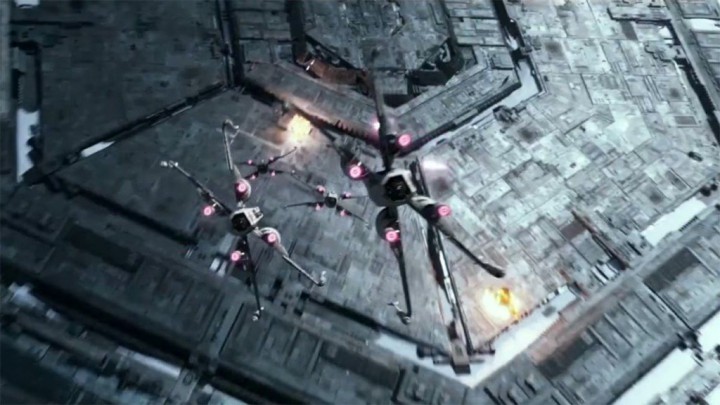
Also they keep getting their hands on the plans. We need to do something about that too.

Also they keep getting their hands on the plans. We need to do something about that too.

Following their victory all credit is given to adherence to “The Light Side” of The Force stoking the superstitions of the Galactic populace from whom they receive financing, support, morale, recruiting and perceived initiative. All they need to do is repeat this cycle every few years or so to keep up the appearances of a viable fighting force.

But stepping back to an orbital view we see the Rebellion and their forebears in the Resistance have only ever had one base with a handful of leaders. Even when Hoth proved conventional, well-led attacks of specialized troops easily sweep their forces aside, we ignore this victory and inexplicably continue to pursue the untenable solution of Death Stars.  Are the vendor relationships within our organization so powerful we will allow them to lead us to defeat after defeat for a few plumbing and thermal-shielding contracts?

The First Order is about removing disorder and restoring stability to ensure progress. I understand why, in the light of our core principles, something like a Death Star/Starkiller seems like a seductive solution. Simply excise the disorder from the galaxy with a single, quite frankly thrilling, giant beam and no more messy impediments to our decretion. But the practical execution of this concept has led us down the path of fatal single-mindedness. Disorder is our enemy, yes, but disorder is the engine of novelty which can be turned against us if we continue to pursue a single course rather than a diverse, calculated military strategy to defeat the Resistance once and for all.

I beg you to consider my plea to divert from this course and shutter the Death Star/Starkiller programs for good.

Yours, Obediently,

Lt. Commander M. Wenchel Gendar

Director

Moff Tarkin School for Strategic Studies

First Order Academy of the Outer Rim

 

Away in a Manger: My Life as Livestock

There are plenty of reasons to love the holidays—even for people like me without children in their homes or Christ in their hearts. The carols and the twinkling lights are obvious charms. So too is the scent of evergreen and wood smoke. Subtler but equally potent is the way holiday advertisements persuade me of my generosity. According to the moral calculus of Target and Best Buy, all I must do is lavish gifts on my materially comfortable friends and family, and I’m excused for the past fifty weeks of being a garden-variety asshole.

But more than anything, I love the holiday season because it’s the one month when my year-round eating habits suddenly seem normal. At Christmas dinner, nobody bats an eye as I politely exchange my china for a wooden cutting board—then methodically erect three edible tiers. Using rolls and biscuits as cobbles, I first lay a sturdy carbohydrate foundation. Next, I spoon the casseroles and potatoes into a sort of quivering, cream-based mortar. Then on top I carefully assemble a flavorful façade of meats—which, at any holiday meal in my native South, will include roast beef and turkey, as well as ham studded with cloves and salted with the tears of Gwyneth Paltrow.

For me, a holiday meal is not so different from an average Tuesday night in April. The fare may be simpler and less butter-laden—salmon over rice, let’s say—but the result is the same, calorically-speaking. Because when I say “salmon,” I mean “a salmon”—or, at least, as much of the slippery devil as I can wrestle onto the top rack of my oven. True, I may steer clear of the eyeballs and fins, but otherwise I go after sockeye like a hibernation-wasted Kodiak bear.

Bear

In my household, I do the grocery shopping and cooking. It’s good exercise to crisscross Market Basket with racks of beef ribs and a burlap sack of potatoes slung over my shoulders. Moreover, it would be cruel to force my wife to handle so much food that she will never eat—and unfair to encumber her with the ceaseless task of keeping my stomach topped off.  When, as is often the case, hunger pangs awaken me at 3 AM, I only have myself to blame.  That’s what I get for not capping the evening with a glass of warm milk and a large pizza from Mike’s.

My wife knows that, when it comes to food, she has only one responsibility, which is to keep her hands and arms away from the chipper-shredder that is my mouth. The comparison is only a slight exaggeration. As an eater, I am not only immoderate, but also indiscriminate. When people tell me about their distaste for olives or their gluten sensitivity, I listen sympathetically—but with profound incomprehension. The notion of a meal “not sitting right” is, for me, a pure abstraction, like division by zero or leftover bacon.

Dining outside my own kitchen, I always feel a certain anxiety about getting enough to eat.  After all, at dinner parties it’s stressful to excuse myself, when everyone else is chatting over half-eaten pie, and go rummaging for more calories. I generally have a pretty good nose for the whereabouts of the hosts’ pantry. But it’s sometimes hard to judge—in the heat of the moment—which snack foods their children are least likely to miss.

At restaurants, especially fancy ones, things can get awkward.  A recent exchange went like this:

Waif-like server with sleeve tattoo: “Finished with this, sir?”

Me (looking down at a bay leaf and a cleanly gnawed bone): “Yes. I’ll have another.”

Server: “Another merlot, sir?”

Me (avoiding my wife’s imploring eyes): “No. Another dish, please.”

Server (smiling and searching my face to confirm the mischief): …

Me: “Another lamb shank.”

Server: “Oh.” (Pause.) “Yes, I can box up another to go.”

Me: “No, I mean to eat. Like, now.”

Wife (helpful and considerate, as ever): “Or, you know, whenever it’s ready.”

Server (dazed, recalibrating, ashamed for me): “Yes. Okay.”

Me: “Thanks for understanding. It’s a problem I have.”

Server (slinking away): “Mm hmm…”

Me: “Miss?”

Server: “Yes?”

Me: “Another merlot as well.”

At this point, I suspect you are picturing me as a large man—or perhaps some mythological hybrid with a chambered stomach. So I feel compelled to state that I am, in fact, 5-foot-8 and decidedly stringy. You can go ahead and carry on about how lucky I am to eat what I want and get away with it. I won’t protest. But let me remind you that the calorie is a unit of thermal energy—and the laws of chemistry cannot be escaped. So you might, more accurately, picture me as one of those old-timey, coal-fired boilers. But since I’m not attached to a steam locomotive, all my heat must be dissipated through my pores.

I didn’t fully appreciate just how sweaty I am until a few summers ago, while vacationing with my extended family near Cancun. Our resort offered a variety of amenities, including six pools and one cramped gym. Inexplicably, it was the only place on the grounds that lacked air conditioning, and its ceiling was scarcely tall enough to accommodate a hoisted dumbbell. On my first visit, I hopped on a stationary bike and commenced to ride with my usual gusto. With my headphones on and engrossed in a trashy telenovela, I was at first oblivious to what was unfolding. My aerobic output—stoked by the resort’s all-you-can eat buffets—had combined with the gym’s jungly heat to generate the perfect metabolic storm.  Eventually, I became aware of some commotion behind me. I turned to find two hunched maintenance workers squeegeeing sheets of my perspiration toward a drain hole in the corner of the rubber floor. Ever mindful of guest safety, they had placed yellow cones along the perimeter. Piso mojado, they read—which, I think, translates to “sweat gully.”

H_2838_MWhen I returned to the gym two days and many churros later, the gym attendants recognized me immediately. One wide-eyed woman hissed over her shoulder, “Mira! Look!” Her colleague wheeled and, perhaps dubious of American bilingual education, muttered a string of epithets that could have served as a vocabulary unit titled, “Odors of the Barnyard.”

One reason I moved from the South to New England was that I was tired of being el cerdo, the pig, for nine months of the year. Here in Gloucester, I can usually count on bitterly cold winters to provide a respite—or at least an excuse to layer over the dark stains that bloom across my chest and back. Normally, after Christmas dinner, I like to slip out the back door, open my jacket, and let the steam rise off me like a piping soufflé. But this year I’m headed back South, and word is they’re calling for record heat. Who knows: maybe this will be the year I find religion once again. If there’s any truth to those carols—“Away in a Manger” and all the rest—the Baby Jesus was never too good to consort with the likes of me.

THE CLAM INTERRUPTS YOUR SATURDAY WITH AN IMPORTANT MESSAGE

We know, Clamfans, you’re probably a little sad we don’t post as often anymore. We have good reasons – Jim is working his butt off starting his own ad agency while supporting a whole family, KT is in the middle of a divorce w kids, moving, and trying to build a social media marketing business (she is also speaking in the third person right now). We apologize for the lull, but it won’t always be this way – 2016 will bring blogging back. We can’t guarantee every day, but it’ll be more quality over quantity. Probably. 

However, WE NEED YOUR ATTENTION FOR A SECOND.

A ton of you guys know Peggy and Chris Lyman. They are locals here, with four (FOUR) kids, including a toddler/preschooler and a brand-new baby. They’re fixtures, they’re One Of Us, and they are part of the social fabric that keeps Gloucester awesome. They’re in the Clam gang, virtually, if one existed (it doesn’t, we lost most of our gang to a rival comprised of mostly Juggalos). They’re the rare breed of people who nearly everyone knows, and no one can say a harsh word about. You know those people. Yeah. The Lymans are them. 

Anyway, Peggy’s doctors just found a mass between her lungs. Right smack dab before Christmas. No one deserves that news, let alone this family who aren’t exactly living in a McMansion with a heated pool encroaching on Dogtown. Peggy’s a schoolteacher, Chris works with boats and busts his butt, and they’re raising 4 young kids. Have I mentioned the four kids?

ONLY HALF THE AMOUNT OF CHILDREN THEY ACTUALLY HAVE

ONLY HALF THE AMOUNT OF CHILDREN THEY ACTUALLY HAVE

So for this holiday season, they’re facing a lot of unexpected transportation – both for Peggy for cancer treatments and the kids around town – and childcare needs, as well as other expenses. Peggy’s cancer is treatable and her prognosis is relatively good, and she’ll obviously be facing a lot of medical interventions starting really damn soon. The last thing Chris, Peggy, and their kids should have to worry about during this time is if they are going to be able to stay afloat financially – they need to concentrate on mom’s health. 

This is Gloucester, and the best thing about Gloucester is how we come together when we’re needed, to help out our own. We’re damn good at it – we prove that time and time again. And it’s time to do that for the Lymans. We live near a world-class city for cancer treatment. We have a lot of hope.

We can’t control cancer, but what we can control is all the external factors this family has to deal with. So let’s make it easier for them – all six of them.

Here’s the gofundme that BYG czar Lara Lepionka put together. Please donate if you can!


Josh Turiel’s Take On San Bernardino

[ed: This is a guest post from Josh Turiel because your regular Clam editors are just too exhausted and drunk to post another goddamn diatribe on our outrageous gun problem. Also, if you’re unfamiliar, “Daesh” is the word we now use to describe ISIS. According to a Globe editorial, “Depending on how it is conjugated in Arabic, it can mean anything from “to trample down and crush” to “a bigot who imposes his view on others.” And basically, ISIS hates it so let’s do it from here on out. USA! USA!]

So the San Bernardino shooters were a couple, apparently led by the woman, who were inspired by ideology to commit terrorism. Which means that OMG Daesh is here.

Except they aren’t here. What we have is a dangerous hybrid of terror wannabes who aren’t part of any organized effort. Some have been overseas and exposed to the extremism virus over there. Some have been following it here and been inspired by Facebook, news coverage, Twitter, and bajillions of things you’ve never heard of. Maybe there’s one nutty charismatic Iman at a local mosque who inspired someone.

Or maybe they broke down and went rogue after listening to this the entire goddamn length of the Pike

Or maybe they broke down and went rogue after listening to this the entire goddamn length of the Pike

In a lot of ways, that’s more scary than if Daesh were actually here in this country setting up operations, but it’s less dangerous overall. America is a pretty free nation, despite what nutters on both sides may think, and there’s always going to be that risk that a couple of people will be inspired by whatever ideology and do something horrible. We’ve been dealing with domestic terrorism for a lot longer than most of you think.


Remember Timothy McVeigh and his partner Terry Nichols? Yep. Domestic terrorists inspired by radical ideology to commit the Oklahoma City bombing. But it was Christian ideology, developed right here at home. The Atlanta Olympic bombing along with several others? Eric Rudolph, a member of the Army of God. Christian. The Sikh Temple shooting? Wade Page, a white supremacist. This past June, Dylann Roof killed nine people at a Methodist church in Charleston, South Carolina. Remember the guy in Colorado just a week ago?


There’s plenty more.


I’m not saying that Muslims are blameless, either. We remember the Tsarnevs pretty well in these parts. Nidal Hassan killed 13 people on the Army base where he worked (he was a US Army Major) at Fort Hood, Texas. Also that year, Abdul Muhammad killed one man and wounded another in a drive-by shooting in Little Rock, Arkansas. There are plenty of instances that a simple Google search can find of arrests and interrupted plots.


The reason that most of these would be terrorists are caught and arrested before they can try to do harm is simple. They organize. They set up groups and networks. A group of people acting suspiciously sets off alarms in law enforcement. They aren’t so good at keeping secrets. They’re noticed, and ultimately arrested. Our FBI isn’t perfect, but they’re pretty damned good – and working with local and state law enforcement they usually stop these plots before they go anywhere.


Note that in the above paragraph I did NOT say “Islamic terrorists”. Law enforcement is good at catching terrorist plots regardless of religious or ideological motivation.


As I mentioned at the beginning, the problem for us (and this is inherent to any society that’s even slightly free) is the lone actor. The married couple. The one angry person and his or her close friend. The brothers. They form a self-contained unit, rarely set off warning signs, and aren’t usually interested in surviving their acts so much as they are sending a message.

The scary thing about it is the simple truth that WE CAN’T STOP THEM ALL. Every city has some potential people that could fit. Every backwoods could have a rusty old trailer with a McVeigh living there. Every neighborhood can have Tsarnev brothers. We never know for sure.


Should that make this country into something else that’s meaner, more suspicious, and more xenophobic than it’s been for generations? I hope not. I don’t blame all my Christian friends for Eric Rudolph. I don’t blame my Muslim friends for the Tsarnevs. I also understand the actual nuance between Daesh as a fighting force in Iraq and Syria, and Daesh as an ideology that has inspired a new wave of nuts in Europe, Asia, and America. We can pretty easily defeat the military Daesh. But it doesn’t stop the people here that are motivated by them. This is the problem we face as a nation and as a people.


That said, if you think that this sort of existential threat is best suited to Facebook memes about Obama being weak because he understands the difference, too? Well, you’re a fool – and you’re probably not reading this article, either. You don’t get nuance. OK, it takes all sorts.


Basically, to sum this up, we have two real military foes right now. Both are extreme fundamentalist Islamic-inspired groups – the Taliban in Afghanistan, and Daesh in Iraq/Syria. We also have a global problem with terrorism committed mainly by individuals and small teams that are inspired by these groups, and by other extreme religious groups around the world. Religious-inspired violence and terror has been a problem for societies since before the modern era. It remains one today. Here in the United States, the Islamic threat of the last twenty years or so is added to the Christian and racially-inspired terror we’ve dealt with since before the Civil War. We need to fight this as a nation without letting the fight destroy us as a nation.


And based on the rhetoric I see all the time, even from serious candidates for this nation’s highest office, we’re not doing so good at that. We’re better than this, people.

Oh Holy Night of the Living Dead

There is stuff to like about the holidays. There’s a lot of free booze around, for instance. It’s less socially awkward to crank down an entire tin of cookies in the middle of the workday than at other times of the year, so bonus there. But beyond these specific advantages your beloved The Clam finds much of the rest to be a massive pain in the dong. We would happily trade the  month-plus pageant of consumption and groupthink for a compressed week of vapid hype culminating in an orgy of binge-eating/power drinking, making it tolerably more like every other week of the year for us. But trade or no, the point remains: The October-January extended “Festive Quarter” has gotten fully the fuck out of hand. It’s exhausting and unnecessary.

In fact, we find the encroaching holidays share many parallels with one of our favorite genres of literature: The Zombie outbreak narrative. Observe:

STAGE 1- September:

Walking into Costco you are shocked by the abrupt first flare-up, a full aisle of animatronic decorations just days out from Labor Day Weekend. Your avoidance response is identical to finding a mangey one-eyed raccoon on your back porch in broad daylight. “I want no fucking part of this,” you say, putting as much distance between you and it as is possible.

racoon

STAGE 2- October:

The outbreak is no longer isolated to select pockets and is developing more rapidly than anyone expects. Confusion reigns, with stores, pop radio and the inflatable holiday decorations on lawns around town showing a strange mixture of symptoms. Mostly it’s the increasingly virulent but generally harmless Halloween strain which clears up after about a week. But more and more you notice evidence of the much longer-sustaining early-onset ChristmasN2 mixed in with the otherwise benign pumpkins and skeletons. The sickness has obviously gained a foothold and won’t be going away.

The government seems powerless to respond. “Which holiday is that guy dressing as Santa for?” you ask in a climate of growing unease.

STAGE 3-November:

It’s now obvious something is seriously wrong. Going out in public is no longer safe as it’s become impossible to tell which locations have been infected and which remain clean. Example: You know from experience the bathrooms on board commuter rail trains are like a particularly nasty porta-potty bouncing around inside a giant maraca, so you pop into a nearby Dunkin Donuts to use the loo. Upon entering you are exposed to a full five seconds of “Wonderful Christmastime” at full volume. You retreat, realizing getting splashed with blue dookiewater is less risk than being subjected to an additional stanza.

Get me! I'm givn' out Wings!

Get me! I’m givn’ out Wings!

Short-sighted local officials are making the problem worse by creating early infection sites where the sickness can take hold. Wreaths are going up. Public displays are being installed. We are told told not to panic, reassured most of the current activity is only the serious but survivable Thanksgiving Simplex which only tends to take out the highly emotionally vulnerable. “How is this all happening so fast?” is the question on everyone’s lips.

STAGE 4-Black Friday:

PUBLIC EMERGENCY DECLARED. Riots and deaths as the infection has broken out everywhere at once, seemingly from nowhere. The TV and Internet burst with images of victims thrashing wildly and attacking each other while store clerks and police stand helplessly by. Grainy security video shows a neverending loop of sufferers going stark raving bonkers over half price mass-market kitchen appliances, demonstrating the plague attacks neurological pathways first, assailing the parts of the brain responsible for maintaining social norms. To see a mother stomp on a child over a fifteen dollar Black and Decker waffle iron fills the world with horror. Also will not make pizzelle or crepes so not even worth it. Prayers go unanswered.

Only 28 Days until Christmas!

28 Days of Christmas

STAGE 5 -Early December:

Nietzsche once described hope as the “worst of all evils” because it can only serve to prolong inevitable suffering. It has become clear the possibility of a “light outbreak” with “maybe just a few family and close friends” was a fool’s fancy. We are now obviously engulfed in a full-blown Pandemic. Everyone knows at least one seriously infected person and observing their distorted behavior as the malady takes hold is wrenching. The only bright spot (Nietzsche notwithstanding) is the infected still tend to cluster together in retail centers where they are essentially contained. However there are frequent incidents where they break free and maraud through offices and schools in search of new victims. No one is safe. Your pleas for the military to bomb the worst-affected sites prompts only a “wellness check” on your residence from the local constabulary.

Can they not see how all forms of media have become dedicated to the epidemic? Society has been transformed, with everything functioning around managing the outbreak. Citizens mark their homes to indicate afflicted dwelling within and no neighborhood has escaped, not even Chinatown or Brookline. Residents struggle to cope but cannot keep up with the stretched infrastructure and supply demands of a population under siege. Suicides increase. Many turn to alcohol and drugs. Mental health resources are pushed to the breaking point. Your attempt at weakening the assault by introducing Shane MacGowan and Kristy MacColl’s “Fairytale of New York” to holiday playlists has no observable effect. You feel like Gandalf in the Mines of Moria. “They are coming.”

No we don't make fucking toys!

No we don’t make fucking toys!

STAGE 6- Late December:

All systems have succumbed to the sheer overpressure of the rampaging epidemic. The gravely infected have broken free and are running amok. What was once pity for the victims gives way to searing rage as survivors search for increasingly scarce sanctuary.  Civil control has broken down, surrendering to the critical mass. The plague is now everywhere: Japan, the International Space Station, even submerged nuclear submarines on patrol have all reported levels of exposure. It’s ability to penetrate every defense defies rational explanation.

Oh no! The virus has made the jump into daikaiju! Run for your lives!

It’s made the jump into daikaiju! Run for your lives!

Survivors scurry from moment to moment trying to limit exposure. Mostly they stay inside cut off from the outside world, or take to the forests and hills on long walks to keep out of the path of potential vectors. Public places such as malls are no longer option as the newly infected now throng there and yet the military still does nothing. It’s like the flamethrower had never been invented.

Schools and offices are shuttered. Non-holiday commerce grinds to a halt. No sanity remains as “Dominick the Christmas Donkey” blares from speakers, cars sport antlers and red noses. The weakened strain of holiday pathogen used to inoculate Jews for centuries (much like vaccinating with cowpox to prevent smallpox) is now past, but the deranged still shriek “Happy Hanukkah” at them anyway, which is like wishing someone a happy Independence Day in August. Jews, ever the survivors, find their ways to safe houses and secret dining establishments to wait out the remainder of the scourge.

Mercifully it at long-last burns out. Nothing so hot or bright can sustain and first one by one, then as a mass, the hosts succumb. At last, merciful silence.

STAGE 7- Aftermath:

Society has been transformed. Not a man, woman, child or pet has escaped untouched. Citizens’ health and personal finances are in tatters. Relationships are worn thin. Waste Management trucks grind under the strain of hauling away the refuse. Nothing lies ahead but long, dark days of toil as we attempt to rebuild. Assurances of increased vigilance are made, “We’ll keep it small next year.”

Just something chill and tasteful with your hipster friends Hahahaha! You'll wind up in Wrentham with your Tea Party cousins again.

Just something chill and tasteful with your squad… Hahahaha! Just kidding! You’ll wind up in Wrentham with your Tea Party cousins again.

You finally emerge into night to watch your cold breath against the stars. You have survived this round, who knows about next? You think of Camus: “All I maintain is that on this earth there are pestilences and there are victims, and it’s up to us, so far as possible, not to join forces with the pestilences.”

You remind yourself not to read Camus.